Virtual Oscilloscope for Substations
Business Overview
Redeia operates Spain's high-voltage electricity transmission network as the country's Transmission System Operator. This role extends far beyond keeping the grid operational. TSOs are central to integrating renewable generation into the European electricity system and developing the new transmission infrastructure required for this transition. Redeia carries out this work with a declared commitment to the sustainability of the electricity system and environmental protection.
Inside substations, however, the technology worked against this pace of change. Manufacturers traditionally marketed protection and control systems as an indivisible package of hardware and software. As a result, substation functionality could only evolve in line with the replacement cycle of the equipment on which it ran, leaving little scope to select the best technology for each function.
One such function was the oscilloscope, the instrument used to measure and analyse the waveform, frequency, and quality of the transmitted electrical signal. Operators rely on it to identify problems and confirm that the system is working correctly. Redeia set out to virtualize this instrument by creating an operating environment independent of any specific hardware or operating system, capable of representing substation operations as a real-time digital model. Barbara's platform provided the edge infrastructure on which the virtual oscilloscope would run. To prove its performance, Redeia chose the most demanding function in the substation, as no other workload generated data at the same frequency as the oscilloscope.
Challenges
Turning a physical instrument into software running on a general-purpose edge node inside a live substation presented several challenges:
- Protection and control systems locked to their vendor's hardware: Because these systems were sold as a single hardware and software package, Redeia could neither evolve substation functionality independently of the equipment nor combine services from different providers.
- Extreme data frequency at the edge: The containerized algorithms needed to receive, generate, and publish thousands of datasets per second, each containing four voltage and current levels. Processing this stream without careful management would have saturated the edge node's CPU and disk.
- Centralizing raw substation data was not viable: Transferring such a large volume of high-frequency measurements outside the substation would have generated significant connectivity and storage costs while exposing sensitive operational data.
- Limited real-time visibility of substation status: Without a detailed live view of the electrical signal, operators had to travel to the site to identify and resolve problems or anticipate failures.
Solution
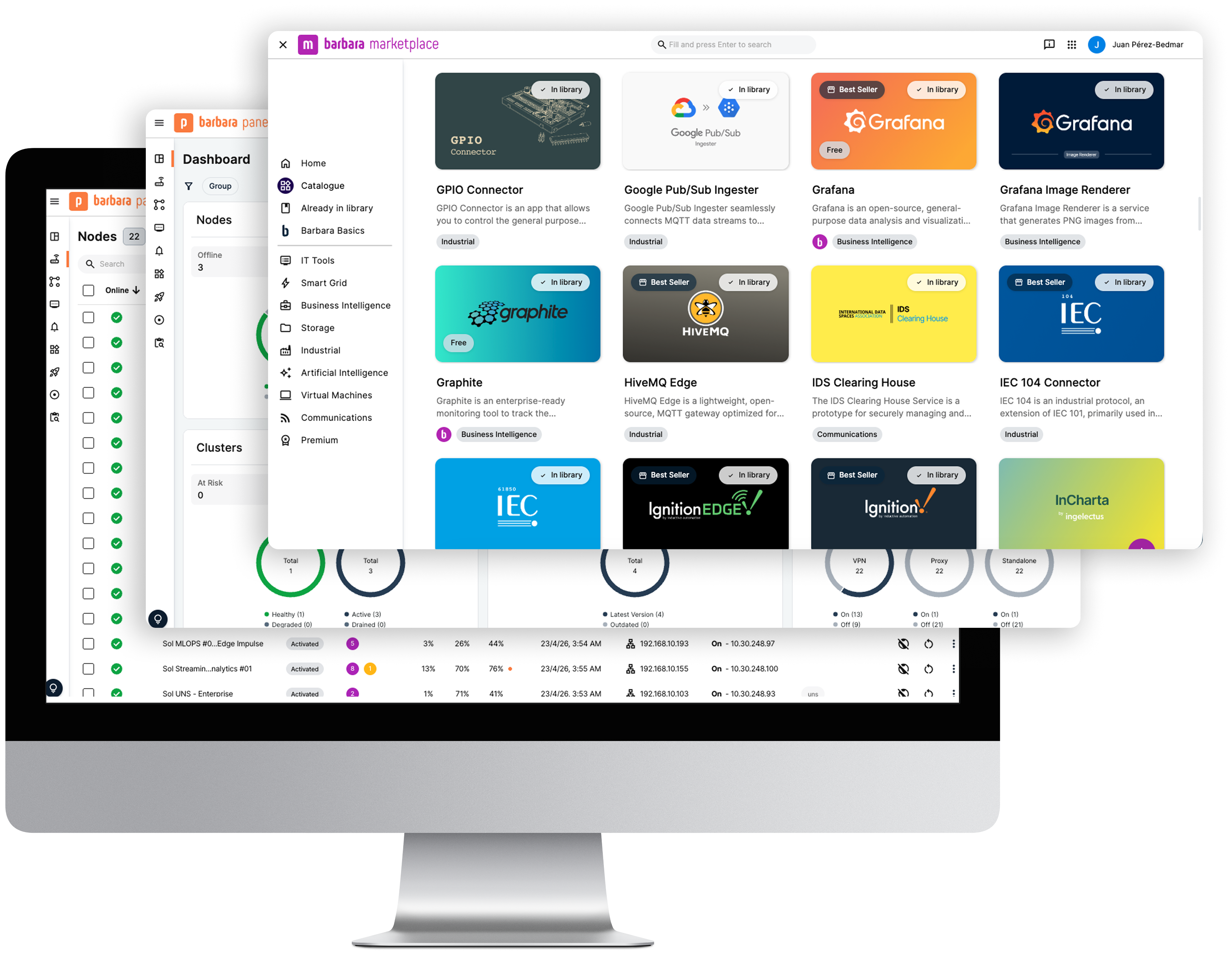
To integrate the virtual oscilloscope into Redeia's global architecture, the company equipped a live transmission substation with a thin edge node running Barbara Core, embedded in Advantech EPC-C301 hardware. Barbara Core provided the runtime for the containerized microservices, or workloads, that formed the oscilloscope. It also kept the node remotely manageable, fully patched, and continuously protected against known vulnerabilities. Barbara Panel gave Redeia's team a single environment for managing both the node and the lifecycle of everything running on it. This included deploying the node with its network configuration and connectivity certificates, collecting application-specific telemetry to monitor performance, delivering OTA firmware updates to the thin edge node, and remotely configuring or reconfiguring its workloads. Many of the workloads forming the oscilloscope came from Barbara Marketplace, where they were available off the shelf. This allowed the team to assemble the architecture from certified applications instead of packaging each one independently.
.png)
The virtual oscilloscope comprised the following workloads, all running on the edge node inside the substation:
- IEC 61850 Connector: Acquired sampled values and events published over IEC 61850 by the protection and control systems, measurement equipment, and intelligent electronic devices (IEDs) installed in the substation. It covered both sampled values (61850-9-2) and GOOSE events (61850-8-1) with MMS reporting. Its handling of GOOSE events was essential to performance. Rather than processing the complete stream continuously, the connector used each event as a trigger to capture the sampled values immediately before and after it. Combined with optimized batching for the high volume of data, this approach kept CPU and disk consumption under control while sustaining 4,000 samples per second.
- MQTT Broker: Distributed the acquired data locally among the workloads running on the node, separating acquisition from processing, storage, and visualization.
- Node-RED: Provided a low-code service for building simple data flows on top of the information circulating through the broker and serving additional dashboards alongside the main oscilloscope display.
- MQTT to InfluxDB Ingester: Transferred data published on the broker to the time-series database.
- InfluxDB: Stored time-series data locally on the node, keeping the high-frequency measurements and their quality marks inside the substation.
- Grafana: Rendered the stored waveforms as the oscilloscope display, giving operators a graphical representation of the signal before and after each event.
Operators could access these displays without travelling to the substation. Barbara's built-in VPN service provided secure remote access to the web interfaces of the workloads running on the node. The data therefore remained inside the substation while authorized personnel could work from anywhere.
Results
The virtual oscilloscope entered service with the most demanding workload in the substation and delivered the required performance:
- 4,000 sampled values per second processed at the edge: Triggered by GOOSE events, the node received, stored, and displayed voltage and current measurements together with their quality marks, all without saturating its CPU or disk.
- Reduced O&M costs: Early detection of anomalous behaviour, combined with remote node management, reduced corrective work and minimized the on-site visits previously required to diagnose problems.
- New use cases without additional investment: Once the edge infrastructure was in place, Redeia could add applications to the same node and replicate the architecture across substations without further hardware expenditure.
- Technological independence from vendor packages: Dividing the solution into independent workloads allowed Redeia to integrate services from different providers, each using the technology best suited to its function. This removed its dependence on the indivisible hardware and software packages supplied by protection system manufacturers.
Conclusions
By running the oscilloscope as a set of containerized workloads on Barbara's platform, Redeia separated substation functionality from the hardware to which it had traditionally been tied. Operators gained detailed and accurate real-time visibility into the state of the substation. The demanding nature of the chosen workload also gave this result broader significance: if an edge node could sustain the oscilloscope's sampled values without becoming saturated, every other substation use case could run comfortably on the same infrastructure. What began as a way to deliver one function became a general-purpose edge foundation ready to be replicated across the network.
The change also accelerated the pace at which substation operations could evolve. Because software advances more quickly and cost-effectively than hardware, a virtualized infrastructure allows Redeia to update and improve substation operations more frequently and plan maintenance more efficiently. The virtual environment also makes it easier to simulate emergencies and develop contingency plans, improving visibility into potential risks and threats. The underlying platform meets IEC 62443-4-2 security level 1, the cybersecurity-by-design level expected of critical grid infrastructure.
About the Company
Redeia is a global operator of strategic electricity and telecommunications infrastructure and a key player in the energy and digital transition. Founded in Spain in 1985 as the world's first Transmission System Operator, the company is responsible for operating and maintaining Spain's high-voltage electricity transmission network, ensuring a secure, reliable, and increasingly renewable power supply.
Through subsidiaries including Red Eléctrica, Reintel, Redinter, and Elewit, the company also advances connectivity, international energy projects, and technological innovation initiatives. With more than 2,000 professionals and operations focused on sustainability, digitalization, and grid resilience, Redeia plays a central role in enabling renewable energy integration, expanding transmission capacity, and accelerating the transition toward a more sustainable and connected future.